
Nationalism is irrational
Unfortunately, the world is too.

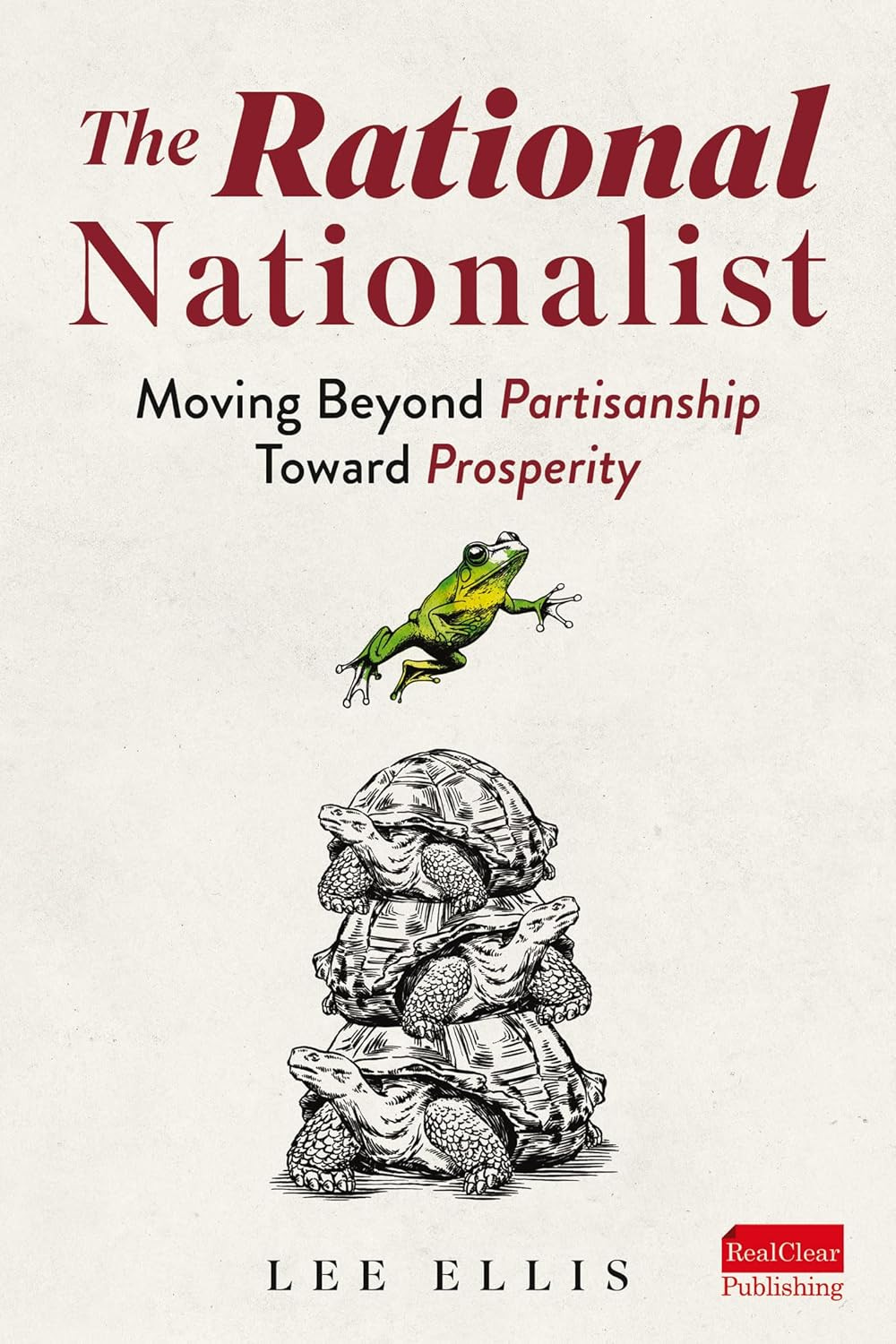
It’s a bold move for anyone to write a book on nationalism, let alone put the word in their title, but its increasing acceptability is an unfortunate sign of the times. Our current age of decline and transformation is inspiring a wide range of alternative political philosophies like Curtis Yarvin’s infamous ‘Dark Enlightenment’, which is being readily adopted by tech billionaires. With The Rational Nationalist, Lee Ellis is throwing his philosophy into the mix — like a swinger depositing their car keys into the bowl and waiting to see what results.
His stated aim of ‘Rational Nationalism’ is to enable the United States to “overcome our divisions and…focus on strengthening our nation” by prioritising “the national good over one’s individual self-interest.” His definition of “good” goes unexplored, but the larger issue with the foundational premise of his philosophy is that ‘Rational Nationalism’ is an oxymoron. He defines rationalism as using logical and objective reasoning to make decisions. Nationalism is the dedication of one to one’s country, and a country is not an objective reality - it is an abstract social construct that only exists in the minds of those who believe in it. Thus, nationalism is irrational.
When Ellis promotes subordinating one’s needs to the needs of one’s country, he refers repeatedly to the economic and military strength of the United States - neither of which recognise borders, with money flowing freely across oceans and sovereign nations repeatedly being invaded and exploited by Western powers. Therefore, what ‘Rational Nationalism’ truly entails is the prioritisation of the needs of the economy.
Requiring “loyalty to the well-being of the nation, prioritisation of national interests over partisan or personal interests” is halfway to Benito Mussolini’s Doctrine of Fascism. Mussolini demanded devotion to the nation, as he believed the nation came from the state. So, devotion to the nation empowers the state and those in power. From that perspective, this book acts as propaganda for maintaining the economic and political status quo.
Regarding his philosophy’s approach to law and order, he firmly asserts that “we cannot tolerate any sort of unrest, domestic terrorism, or civil disorder. The law must be respected and obeyed, and those who violate it must be punished.” This relies on people being united in order to be strong, and disallowing in-fighting. He attempts to temper this with the need to write laws that people respect and see as fair, avoiding a repressive approach, as he acknowledges the pitfalls of “attempting to coerce compliance by sheer force”. Nonetheless, his pragmatism only goes so far as he isolates the issues in the political realm, paying no mind to the external influences from financial elites and the markets themselves. This approach ignores the way in which corporate power defines modern politics, overruling the politicians and the democratic process. Taken as a whole, he is endorsing the dominance of economic policy while preemptively quashing opposition to it.
Implicit in his philosophy is a rejection of the globalised economy, placing the economic needs of the United States and its economy before any other countries’. It is an exemplification of his naive understanding of modern economics and an ignorance of the damage that would be done to his country’s economy if they were to pull up the drawbridge - as we are seeing now as a result of President Trump’s knee-jerk tariffs. This naivety is further illustrated by his endorsement of laissez-faire economics as a way to help individuals “to grow and prosper” - a vague, unsubstantiated statement that contradicts the extensive research detailing the damage these types of economic policies have had. An ideology based on empirical data and objective evidence may sound like ‘common-sense’ but empirical data can be easily manipulated and cherry-picked to fit one’s agenda. Reliance on objective data also removes the input of more abstract notions such as happiness and job satisfaction. And since the author neglected to detail his definition of the “good”, it can only be assumed that it would be decided by those in power, legitimately or illegitimately.
By encouraging citizens to subordinate their interests and well-being to that of the “whole”, this philosophy attempts to intellectualise subordination and obedience while the wealthy continue to amass ever greater riches, and the poor are left to satiate themselves with the notion of being a part of something larger than themselves. Being rational, they would have to admit that dedicating yourself to an abstract construct like a country, and subordinating your material needs before that of the amorphous whole, is no different to submitting to a religion, both of which can be weaponised against you.
For ease of understanding, he often distills his philosophy to the metaphor of team sports. His enthusiasm for “openly and unapologetically playing for our team” and “helping your team win” echoes the competitive mindset that is programmed into Americans through a culture that heavily promotes team sports. This is a mindset that is core to sustaining capitalism. By using this metaphor, he attempts to soften the historically fascistic edges of nationalist ideology, illustrated by a revealing statement that appears in the dying moments of the book: “all nationalism boils down to is patriotism”. This statement is objectively incorrect and dangerously blurs the lines between the two, but it reveals his patriotism to be a Trojan horse for nationalist ideology. His desire to see America restored “to its rightful place atop the international food chain” echoes the familiar political refrain of national restoration - ‘Make America Great Again’ - but it raises a pertinent question: is America not already dominant?
I approached this book with an open mind and a morbid curiosity about whether the author could win me over to the concept of nationalism - no mean feat. Alas, he did not. However, he did leave me wanting more, feeling frustrated by his lean explanations. Much of the book reads like a university student reading from an introductory textbook on political philosophy, quoting the classic thinkers in piecemeal wherever they support his philosophy. It’s acceptable as an introduction for newcomers to these ideas, but this book needed to be much longer to fully explore the foundations of his philosophy and their projected effects. A book of only 95 pages may be more accessible to his audience who want to justify their newfound passion for nationalism - likely thanks to President Trump - but the more wizened and worn will be left thoroughly unsatisfied.
Many thanks to RealClear Publishing for the advanced review copy. The Rational Nationalist is released on February 3rd, 2026. This review was written independently.